
Nails have dominated framing jobs for decades, and for good reason. They install fast, handle dynamic loads well and meet code requirements across most structural applications.
However, as project demands grow more complex, builders are finding that nails aren’t always the right tool for the job.
Framing screws offer stronger holding power, cleaner removal and tighter precision. These advantages count in applications where a nail’s flexibility becomes a liability rather than an asset. The tradeoff is speed and cost, meaning the choice isn’t always simple.
Choosing between them comes down to four key factors: strength, flexibility, installation speed and code considerations.
Knowing how each stacks up across structural framing, temporary assemblies and precision applications can make the difference between a solid build and a costly callback.
Structural Performance
The most critical distinction between framing screws and nails is how each fastener behaves under load. Two properties define that difference: shear strength and withdrawal strength.
Shear Strength
Shear strength measures a fastener’s ability to resist forces pushing two connected materials in opposite directions, common in assemblies exposed to wind, vibration, live loads and structural movement.
Nails perform well here. The steel shank flexes under pressure without snapping, allowing nailed connections to absorb impact and dynamic movement without sudden failure.
That ductility is why nails remain the code-preferred fastener for wall framing, roof systems and floor assemblies where lateral forces dominate.
Withdrawal Strength
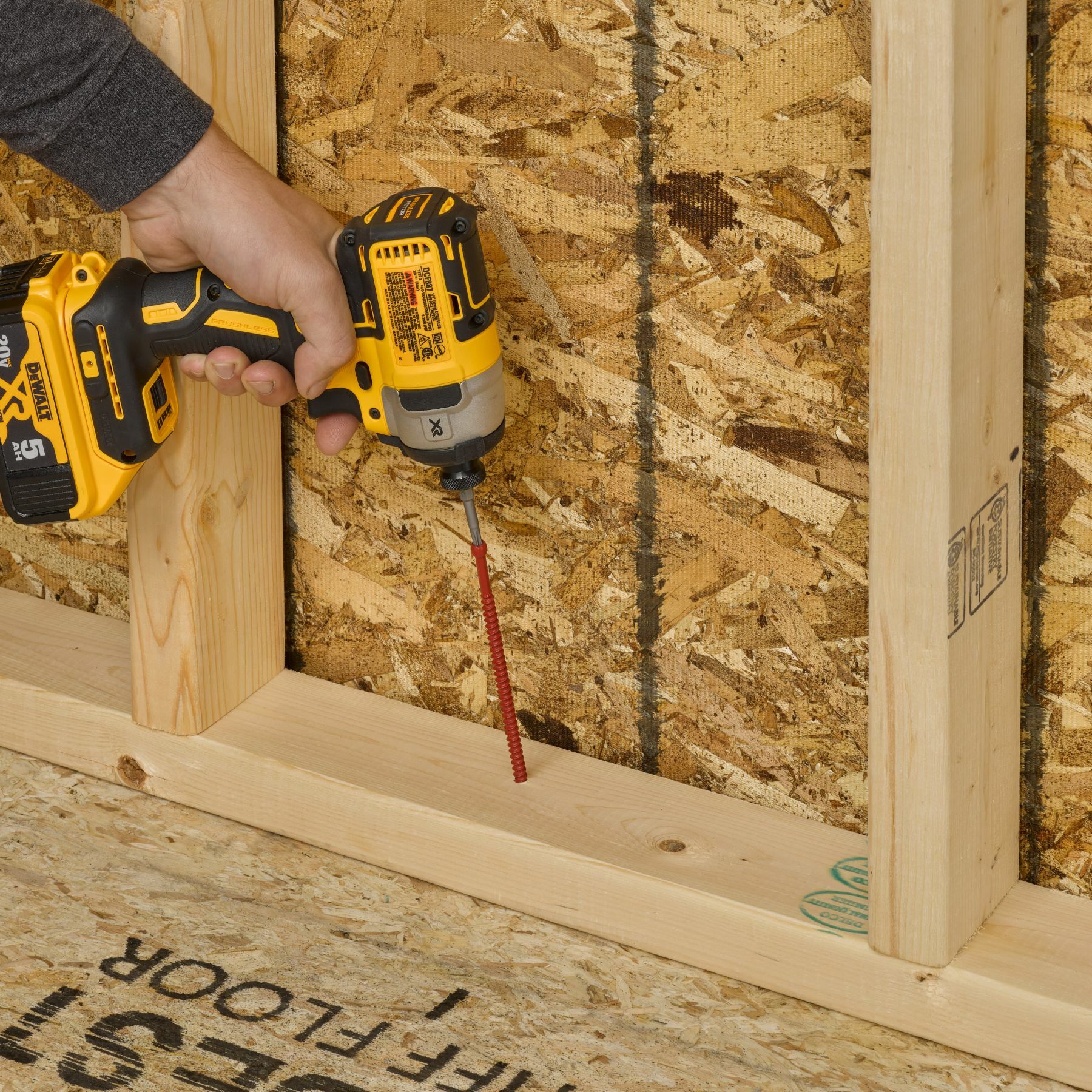
Withdrawal strength measures how well a fastener resists being pulled straight out of the material. The threaded shank of a framing screw mechanically locks into wood fibers, generating significantly greater pull-out resistance than a smooth-shank nail.
In applications involving uplift, material movement or long-term load retention, a framing screw’s threaded grip holds under conditions where a nail will loosen over time.
It’s worth noting that many assemblies place both load types on the same connection simultaneously. A ledger board, for example, must resist withdrawal from uplift while also transferring lateral shear loads from the deck or floor system.
In these cases, choosing the right fastener requires carefully comparing its material properties and strength to the manufacturer’s official rated load limits.
Where Nails Perform Best
Nails are the standard for high-volume structural framing due to speed, ductility and cost efficiency.
For wall framing, floor diaphragms, roof systems and shear wall assemblies, loads transfer laterally through the connection. The nail shank’s ability to flex slightly under pressure allows these connections to absorb shock, wind loads and normal building movement over time.
Pneumatic installation speeds up fastener placement, allowing crews to quickly install enough fasteners to achieve the required shear strength in diaphragms and sheathing systems.
Nails are also a smart choice for temporary and semi-permanent work (ie, job site bracing, formwork, rough sheathing) where disassembly isn’t a priority and installation speed drives the decision.
Where Framing Screws Perform Best
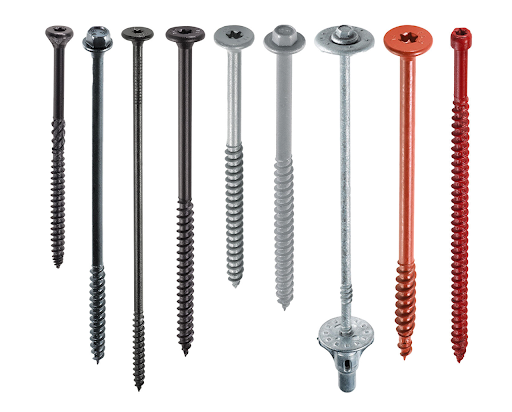
Framing screws are the stronger option for applications where withdrawal resistance, connection precision or rework flexibility are deciding factors.
For subfloor fastening, stair assemblies, blocking and ledger attachments, the threaded shank resists loosening over time, reducing squeaks, movement and callback issues in finished spaces.
That holding power matters most in multifamily, hospitality and tenant improvement projects, where callbacks after occupancy are the most disruptive.
Screws also give installers greater placement control than nails. The impact of a driven nail can shift materials at the last second.
This can be a real problem for door openings, engineered lumber connections, hardware installations and other assemblies where exact positioning is required. Screws seat deliberately and consistently, producing tighter joints with fewer gaps.
In retrofit and renovation work, removability is a real advantage. Because screws back out cleanly with minimal damage to surrounding materials, they’re the best choice for phased work, MEP coordination changes, occupied-space remodels and punch-list revisions where access to concealed framing is often needed.
Cost and Productivity Considerations
Framing screws cost more per fastener than nails, often by a significant margin when you’re looking at volume. That difference adds up fast on large structural builds where fastener counts run into the thousands. For core framing tasks where nails meet the structural requirement, the speed and cost advantage of pneumatic nailing is hard to argue against.
The math changes when callbacks and rework enter the equation. A squeaky subfloor, a shifted door frame or a connection that loosens under repeated loads can cost far more to fix than the difference in fastener price. For applications where screws reduce that risk, the upfront cost pays for itself.
Tool investment is also a factor. Most crews already run pneumatic nailers as standard equipment. Adding screw-based installation means a separate tool set, adding cost and coordination on larger jobs. On smaller projects with more precise work, that gap closes.
Code and Specification Considerations
Nail Schedules and Default Specifications
When choosing fasteners, both performance and compliance requirements must be considered.
Most residential and commercial framing specifications reference nails as the default fastener, and substituting screws requires attention to how the connection is rated.
The International Building Code and IRC nail schedules are designed around common wire nails and pneumatic nails with specific shank diameters and lengths.
Framing screws used in structural applications must be code-listed and carry published load values, but not all screws on the market meet that threshold.
When specifying screws for structural connections, architects and contractors should confirm that the fastener carries an ICC-ES or equivalent third-party evaluation and matches the load requirements of the connection.
Engineered Lumber Connections
Engineered lumber connections come with their own rules.
Manufacturers of LVL, LSL and I‑joist products publish approved fastener lists for their products, and those lists don’t always include generic framing screws.
Using an unlisted fastener in an engineered connection can void the manufacturer’s warranty and create liability exposure if the connection is later scrutinized during inspection or litigation.
Non-Structural Applications
For non-structural applications, like blocking, interior partitions, backing and cabinetry support, code constraints are less restrictive, and screws can typically be used without additional documentation.
Verify Before Substituting
When in doubt, the fastener manufacturer’s specification sheet and the project’s structural drawings are the authoritative references.
Substituting fastener types without verifying load equivalency is a common source of inspection failures and liability on commercial projects.
Select the Right Fasteners from the Start With FastenMaster
Fasteners are decided early, but their impact shows up late: squeaky floors, failed inspections and callbacks that eat into profit. Spec it right from the start, and you add value without adding cost.
FastenMaster makes that decision easier. From high-shear structural framing to precision retrofit work, the full FastenMaster framing line covers every application, with the load ratings and code listings to back it up.
Make FastenMaster your job site standard, and experience the difference that professional-grade engineering makes. Find your local distributor today.